
AI can help with the work around care. It can sort notes, draft a handout, or help a team find a clearer way to explain a service. That support can make room for people. The goal is more time to listen, connect, and care.
A person still needs to decide what belongs in the final work. Human-in-the-loop means a person takes part in an AI task. In care, that person needs the skill, time, and power to check the result and change it. A quick click on “approve” is not enough.
This guide offers a practical review process. It is not a rule that settles legal liability in every case. Duties can depend on your role, setting, state, and tool. Use it with your team's policies and the standards for your profession.
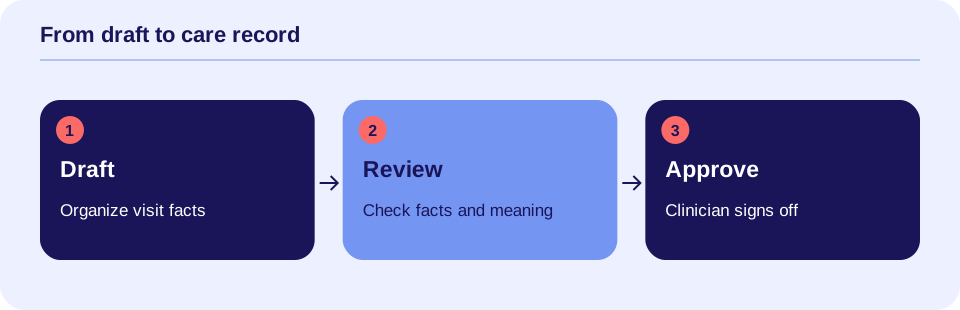
Your judgment shapes the final work.

Give the tool a task. Give a person the decision.
Think of an AI draft as work that is still in progress. The tool may help shape the words. It does not know the client the way the care team does. It may miss a key fact or add a claim that was never made.
For social workers, the NASW Code of Ethics calls for practice within one's skills and knowledge. Its technology guidance calls for the skills needed to use tools well. These are professional ethics standards. They are not an AI law for every care role. NASW Code of Ethics, section 1.04.
A useful split is simple: let the tool help with a clear task. Let a qualified person make the care decision. For example, an approved tool may draft a visit note. The clinician checks it against the visit and decides what to sign. The tool's wording does not replace that judgment.
Make review a real part of the work
Review works best when it has a clear place in the day. Put it before a draft enters a record, goes to a client, or leads to an action. Give the reviewer access to the source facts. Let them edit, reject, or stop the task.
Do not expect staff to review more work than they can check with care. A tool that creates twice as many drafts may add work if each one needs major fixes. Count time spent checking and correcting, along with time saved in writing.
Leaders share this work. They choose the tools, set the workload, train staff, and make sure review can happen. The NIST AI Risk Management Framework calls for clear roles, staff training, leadership responsibility, and defined human oversight. NIST's framework is voluntary guidance, not a law or proof that a tool is safe. NIST AI RMF, GOVERN 2 and 3.2.
A note review that protects the client's story
Here is a made-up example. A client says they have slept poorly this week. They also say a short walk helped them feel calmer. An AI draft changes this to “sleep has improved” and “symptoms are resolved.” Both phrases change the meaning.
The clinician returns to the visit facts. They correct the sleep statement and remove the claim that symptoms are resolved. They keep the client's own words where those words matter. They check that the plan reflects what they actually discussed.
The fix is more than better grammar. It keeps the record tied to the person and the care that took place. Use this short review before signing:
- Match the facts. Check names, dates, symptoms, medicines, and events against the source.
- Match the meaning. Keep doubt, context, and the client's point of view. Do not turn “may” into “does.”
- Check the plan. Confirm that it reflects the actual care decision. Remove steps that were not agreed on.
- Remove added claims. Do not let the tool invent an assessment, quote, service, or finding.
- Approve the final version. Sign only work you have checked and can explain.
These are proposed work steps. Your organization may need other checks for its records and services. For more on the full workflow, read AI and Clinical Documentation.
Match review to the task
A draft staff meeting agenda needs a different review from a draft care plan. Both need an owner. The care plan also needs someone with the right clinical skills. Do not ask office staff to approve a clinical judgment because they can spot spelling errors.
For a general handout, check that the content is sound and easy to read. Confirm it fits the people who will use it. For client-specific material, check it against the person's needs and the agreed plan. For a billing draft, confirm that it matches the service provided and the relevant payer rules. A polished draft does not prove that a charge is correct.
When an output could change care, use a qualified clinician's review before acting on it. A general chatbot should not be the sole basis for diagnosis, treatment changes, or a crisis response. Follow the setting's established clinical process. A human review label does not make an untested use suitable for care.
Keep the relationship in the room
Good review asks whether the result fits the person, not just whether it sounds clear. A handout may be accurate yet too long for a tired client. A plan may leave out a language need or a practical barrier, such as transport.
Ask the client how the final material fits their life. Explain tool use when your consent process or policy calls for it. Make room for concerns and choices. Do not tell a client that the AI “decided” what they need. Explain the care team's own judgment in plain words.
Use approved tools and the approved data rules. Reviewing an output does not fix a wrong choice about sending private information to a tool. Use the data-handling worksheet to record the data path. Read Can I Put Client Information Into an AI Tool? for the privacy steps.
Give staff a clear way to stop and fix the work
Agree on a fallback before a tool is used. If a draft cannot be checked, finish the task through the usual process. If the same mistake keeps coming back, tell the named tool owner. A reviewer should be able to pause a use that needs more work.
If an error has already reached a record or a client, use the team's correction process. Record what was wrong and how it was fixed. Do not quietly change the record in a way that hides its history. The exact steps depend on the setting's rules.
A useful report names the task, the kind of error, and the fix needed. Keep private client details within approved systems. Leaders can use these reports to improve the workflow, change the tool, or end a use that does not serve the team well.
Start small and check the full effort
Try one approved task with made-up cases first. Name the tool owner and reviewer. Write down what counts as a sound result. Test cases that include missing facts, unclear wording, and a client need that does not fit a standard draft.
Before a live pilot, confirm the data rules and approval path. During the pilot, track time spent writing, reviewing, and fixing. Track errors that change meaning, not just typos. Include staff feedback and any client feedback the task makes appropriate to gather. Set a review date and decide when to pause the use.
These are suggested pilot steps, not a validated test or certification. Success means the whole workflow helps. It should make sound work easier, not shift more hidden work to staff.
Keep people able to use their judgment
Human review is a way to make AI useful with care. It connects a draft to real facts, a person's needs, and a clear decision. With the right task and support, AI may ease busywork while the team keeps its attention on people.
The aim is not to make a clinician a last-minute proofreader. The aim is to give skilled people better support, enough time, and a real voice in the work they approve.
Watch for automation bias
Automation bias means giving too much weight to a system’s answer. A polished note can feel official before anyone checks it. Have the reviewer identify the key source facts first, then compare the draft. Give staff enough time and authority to reject it.
A tool’s explanation may sound thoughtful but still be wrong. Review the source, the result, and the effect on the client. Keep a clear record of what was checked. This makes human review a real task rather than a label.
AI-literacy additions reviewed October 11, 2026. See AI Terms for Care Teams for the related terms and examples.
Sources and scope
- NASW Code of Ethics: Responsibilities to Clients. Section 1.04 covers competence, including technology skills. Professional ethics guidance; it does not settle every profession's legal duties.
- NIST AI Risk Management Framework Core. GOVERN 2 and 3.2 address roles, training, leaders, and human oversight. Voluntary framework, first issued in 2023; the source page notes a revision is in progress.
Sources checked October 4, 2026. Examples are made up. The review and pilot steps are practical suggestions, not evidence that a specific tool improves care or saves money. This resource is for learning and planning.